Cryptocurrency transactions may be fast and have limited or no fees, but that possibility is not a service guarantee or proof a casino accepts ETH.

Ethereum Casino Payments: What the Available Evidence Actually Establishes
Ethereum is a cryptocurrency, and the relevant payment characteristic is shared with cryptocurrencies such as Bitcoin: deposits and withdrawals may be processed instantly, with limited or no fees. That describes a possible feature of cryptocurrency transactions. It is not a fixed service term, a promise of a particular processing time, or confirmation that a casino accepts Ethereum.
The distinction matters because payment language can sound more definite than the underlying claim. “Instant” describes a possible outcome, not a guaranteed completion time for every transaction. “Limited or no fees” likewise does not establish that every payment is free. Those phrases set out potential advantages, but they do not specify the terms of any particular service.
For an Ethereum casino payment, the narrow supported point is therefore about the general payment method: cryptocurrency transactions may be fast and may carry limited or no fees. The statement does not establish which operators accept ETH, whether a cashier lists it as an option, or whether the same conditions apply to both deposits and withdrawals. It also does not identify a minimum or maximum transaction amount, a processing schedule, or a fee schedule. None of those details follows from the general characteristic alone.

This is a useful way to read claims about an online casino that mentions Ethereum. A payment method’s potential speed and cost are separate from the operator’s own terms. A service might describe cryptocurrency payments as fast, but that wording alone does not show what happens in an individual case. Similarly, a reference to low fees cannot be converted into a definite fee amount—or into a conclusion that no charge will apply. The distinction is ordinary accounting: a general feature is not a transaction statement.
The same boundary applies to deposits and withdrawals. The general cryptocurrency claim covers both directions, but it does not establish that a particular service handles them identically. A general statement about possible instant processing cannot confirm that a withdrawal will arrive instantly, or that an operator will process one on the same basis as a deposit. Nor does it establish which currency is used to display balances or settle an account. Those are separate terms, not details contained in the payment characteristic.
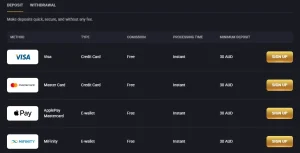 Banking Options and AUD Cashier at Fortune PlayFortune Play's current Australian payments page lists AUD card and e-wallet deposits from A$30 and shows card, bank and cryptocurrency withdrawal options.…
 Casinos That Accept Visa in Australia: Key DetailsLearn why Visa acceptance does not confirm casino availability, how deposit terms and verification matter, and why card deposits differ from withdrawals.
Ethereum may appear in descriptions of casino payments alongside other digital currencies. That association should not be mistaken for proof that a specific cashier supports ETH. A cashier listing, the operator’s terms, and the actual availability of a service are distinct matters. The general payment feature does not supply an operator list and cannot support a recommendation. It is a statement about what cryptocurrency transactions may offer, not a directory of services.
The term “Ethereum casino” can also combine two different ideas: a casino service and a cryptocurrency payment method. The payment claim speaks only to the latter. It does not verify that a casino game, live table, mobile service, or pokie is available, nor that any such service can lawfully be offered in Australia. Treating the payment method as evidence of the whole service would move beyond what the claim establishes.
Australian law sets a separate boundary. The Interactive Gambling Act 2001 prohibits operators from providing real-money online casino games to people in Australia. The fact that cryptocurrency may offer prompt transfers or limited fees does not alter that restriction. Australian consumer law also does not protect people using offshore casinos, so the payment characteristic should not be read as an assurance of consumer protection or a basis for using an offshore service.
A concise reading is the most accurate one: cryptocurrencies such as Ethereum may support instant deposits and withdrawals with limited or no fees. “May” is essential. It keeps the statement at the level it supports, without turning a possible payment advantage into a guarantee, an operator endorsement, or evidence that an online casino service is available to Australian residents.
Assessing Ethereum Casino Claims Without a Verified Operator List
A “best” label is meaningful only when the basis for the comparison is clear. For an Ethereum casino claim, the payment method is one narrow attribute: it says nothing by itself about the operator’s overall terms, reliability, or suitability for people in Australia. A page that places a service first without explaining what was measured offers a ranking, not evidence of quality.
Cryptocurrency payments such as Ethereum may allow deposits and withdrawals to be processed instantly, with limited or no fees. That general payment characteristic does not establish that a particular casino accepts ETH, that its cashier supports it for both directions of a transaction, or that the same timing and cost apply to a particular account. The distinction matters: a statement about cryptocurrency in general cannot settle the terms of a named service.
The same limit applies to descriptions such as “best online casino with Ethereum” or “best ETH casino site.” Those phrases combine two separate claims: that a service accepts Ethereum and that it deserves a comparative ranking. The first requires confirmation of the payment terms; the second requires a disclosed, relevant basis for judging it. Repeating the payment claim does not supply that basis.
A useful comparison would need to separate measurable terms from promotional language. Payment support, fees, processing conditions, withdrawal rules, account requirements and eligibility are different questions. A claim about one does not answer the others. Nor does a smooth deposit process establish that a withdrawal will follow the same route or timetable. Any meaningful assessment depends on the terms that actually govern the transaction, rather than the broad label attached to a site.

Searches for a live-dealer service accepting Ethereum introduce another independent claim. A payment method does not prove that a particular type of service is available, and a general description of casino offerings does not verify access from Australia. The word “best” cannot bridge either gap. It does not turn a payment statement into confirmation of a product or its availability.
Claims about a no-deposit bonus are separate again. A bonus is an offer with conditions, not a feature that follows from accepting ETH. The existence, eligibility rules and withdrawal conditions of an offer would need to be established on their own. Combining a bonus headline with a cryptocurrency payment claim may make the offer appear more complete than it is; financially, the two claims remain unrelated unless specific terms connect them.
Australia adds a decisive boundary to any assessment of casino services. The Interactive Gambling Act 2001 prohibits operators from providing real-money online casino games to people physically in Australia. Consequently, a ranking or payment description cannot be treated as confirmation that an online casino service may lawfully be offered to Australian residents. Australian consumer law does not protect players who use offshore casinos. These are material limits, not minor qualifications to a recommendation.
For that reason, a comparison framed around “best” cannot responsibly be reduced to whether Ethereum appears among payment options. It would need to distinguish what the payment claim establishes from what it does not: a general feature of cryptocurrency transactions does not verify an operator, a full set of transaction terms, a service category, or Australian availability. A confident headline may package those issues together, but packaging is not substantiation.
The practical reading of an Ethereum casino claim is therefore narrow. Treat payment language as a statement about a possible payment characteristic, not as an endorsement or a complete assessment of a casino. Treat a ranking as meaningful only where its criteria and the basis for applying them are clear. In Australia, neither kind of claim removes the legal restriction on operators providing real-money online casino games to residents, or the lack of consumer-law protection for offshore casino use.
What “Best Ethereum Casino” Can—and Cannot—Mean Here
Choosing an Ethereum casino in Australia means checking the details that matter to you, such as licensing information, available payment options and payout times. Use these verdicts as a concise reference based only on the information provided.
-
JeetCity Casino
- License
- Curacao eGaming (Dama N.V.)
JeetCity Casino is listed with a Curacao eGaming licence held by Dama N.V.
-
House of Pokies
- License
- international iGaming licence – jurisdiction not named in the source
- Payout speed
- PayID 1-24 hours
- Min. deposit
- A$30 (PayID from A$10)
House of Pokies lists an international iGaming licence, though the jurisdiction is not named. PayID payouts are listed at 1–24 hours, and the minimum deposit is A$30, or A$10 when using PayID.
-
LuckyVibe
- License
- Curacao Gaming Control Board OGL/2023/176/0095 (Hollycorn N.V.)
LuckyVibe is listed under Curacao Gaming Control Board licence OGL/2023/176/0095, held by Hollycorn N.V.
-
Rollero Casino
- License
- Curacao Gaming Control Board OGL/2023/176/0095 (Hollycorn N.V.)
Rollero Casino is listed under Curacao Gaming Control Board licence OGL/2023/176/0095, held by Hollycorn N.V.
-
Bizzo Casino
- License
- Curacao Gaming Control Board (TechSolutions Group N.V.)
Bizzo Casino is listed with a Curacao Gaming Control Board licence held by TechSolutions Group N.V.
-
Kingmaker
- Payout speed
- crypto ~90 minutes, fiat 1-5 days
- Min. deposit
- A$30
Kingmaker lists crypto payouts at around 90 minutes and fiat payouts at 1–5 days. Its minimum deposit is A$30.
-
Lucky Dreams
- License
- Curacao
- Min. deposit
- A$20 (POLi)
Lucky Dreams is listed with a Curacao licence. Its minimum deposit is A$20 when using POLi.
-
SkyCrown
- License
- Tobique Gaming Commission
- Payout speed
- crypto ~10-15 minutes, fiat 1-5 days
- Min. deposit
- A$30
SkyCrown is listed with a Tobique Gaming Commission licence. Crypto payouts are listed at around 10–15 minutes, fiat payouts at 1–5 days, and the minimum deposit is A$30.
-
DragonSlots Casino
- License
- Curacao Gaming Authority (Jumpman Gaming Ltd)
DragonSlots Casino is listed with a Curacao Gaming Authority licence held by Jumpman Gaming Ltd.
-
MrPacho
- Payout speed
- crypto 30-120 minutes, fiat 24-72 hours
- Min. deposit
- A$30
MrPacho lists crypto payouts at 30–120 minutes and fiat payouts at 24–72 hours. Its minimum deposit is A$30.
“Best” is a comparative claim, not a payment feature. To support it, there would need to be a consistent basis for comparing operators, such as confirmed Ethereum acceptance, transaction terms, account conditions and the service’s availability to people in Australia. A cryptocurrency payment characteristic on its own cannot establish any of those operator-specific points. It therefore cannot identify a best Ethereum casino in Australia or justify presenting a particular site as preferable.
Ethereum can be used as a broad label for a payment method, but it does not settle the terms of a casino account. Cryptocurrencies such as Bitcoin and Ethereum may allow deposits and withdrawals to be processed instantly, with limited or no fees. That general characteristic is not a promise about a particular transaction, and it does not establish that an operator accepts Ethereum from Australian residents. Nor does it show what conditions apply to an account or whether a service is available in Australia.
The same distinction applies to an Ethereum casino list. A list implies that the entries meet a stated criterion and have been assessed on comparable terms. Merely grouping casino names under an Ethereum heading would not establish that each accepts the currency, that the payment route works for Australian customers, or that the services can lawfully be offered to them. Adding a “latest” label would not improve the comparison; recency is not evidence of eligibility or quality.

A bonus cannot supply the missing basis for a ranking. The phrase “best Ethereum casino bonus” suggests that an offer can be compared by its terms and value, but a payment method does not verify an offer. Without established conditions, a headline bonus figure would be packaging rather than a usable calculation. The same applies to claims about casino games, pokies or slots: payment information does not demonstrate that a particular product exists at a given site, is available to Australians or can be offered lawfully.
The Australia-specific qualifier changes the question materially. Under the Interactive Gambling Act 2001, operators cannot provide real-money online casino services to people located in Australia. That prohibition covers casino-style gambling services, including games commonly associated with online casinos. The legal issue is not resolved by using Ethereum instead of another payment method, by describing a site as offshore, or by calling it the latest option.
The law’s focus is on operators providing the prohibited service; it does not make an individual player’s use of an offshore casino a criminal offence. That distinction does not turn an offshore service into a lawful Australian offering. Australian consumer law also does not protect players who use offshore casinos, leaving a significant difference between a payment claim and a protected consumer transaction.
So “best Ethereum casino” can describe a search for a combination of payment support, service quality and Australian availability, but the phrase itself proves none of those things. In this market, a defensible recommendation cannot be separated from the legal status of the service and the actual terms attached to it. A fast, low-cost cryptocurrency transfer may describe one part of a transaction; it does not establish that the underlying casino service is available or lawful in Australia.
Ethereum Slots Bonuses and Deposits: Separate the Payment Claim from the Offer
An Ethereum payment claim and a bonus claim are separate propositions. Information that cryptocurrency transactions may be quick and carry limited or no fees does not establish that an online casino offers a welcome bonus, a deposit promotion, or free play. Nor does it show that any such offer applies to Ethereum deposits. Those are separate conditions, and one cannot be calculated from the other.
The same distinction applies to claims about free play or a no-deposit offer. The label alone does not establish eligibility, withdrawal conditions, or whether Ethereum is relevant to the offer. Without specific terms, there is no sound basis for assigning a cash value to a promotion or treating it as part of a deposit’s return. A headline is not a balance-sheet entry.

A deposit offer also needs to be separated from the underlying transaction. Ethereum may be associated with instant deposits and withdrawals and limited or no fees as a general cryptocurrency characteristic. That says nothing about whether an individual service applies those characteristics to a particular transaction, or whether a promotion changes the amount that can be withdrawn. Payment speed and promotional value are not interchangeable.
Account checks are another distinct condition. Online casinos commonly require customers to pass a Know Your Customer assessment before carrying out financial transactions. That requirement is separate from a bonus label and from the payment method. It does not establish that a promotion is available, that an account will qualify, or that a payment will be processed on particular terms.
For any offer, the relevant calculation would depend on its written conditions: who qualifies, which deposits count, what restrictions apply to funds received, and what conditions govern withdrawal. Assigning a value or implying that an offer is available would turn a payment characteristic into an unsupported commercial promise.
There is also a decisive Australia-specific boundary. The Interactive Gambling Act 2001 makes it illegal for operators to provide real-money online casino games, including pokies, to people physically in Australia. Australian consumer law does not protect players using offshore casinos. A bonus description cannot alter either point, and describing an offer as being for Ethereum users does not make the underlying service lawful to provide to Australian residents.
Do
- Check written conditions for bonus eligibility
- Verify withdrawal rules and restrictions
- Review specific account requirements
Don't
- Treat payment speed as a bonus guarantee
- Assume a bonus is available based on ETH support
- Mistake promotional headlines for usable balances
The practical accounting distinction is therefore narrow: a general statement about cryptocurrency transaction costs or speed is not evidence of an offer, while a promotion’s wording is not evidence of a usable Ethereum payment route. Neither establishes access to online casino games in Australia. A claimed bonus should not be treated as money available to a player unless its conditions and lawful availability are established; in this market, the legal restriction comes before any promotional arithmetic.
Ethereum and Casino Games: The Australian Legal Boundary
Ethereum is a payment method, not a legal exception for casino games. Whether a game is described as an Ethereum casino game or presented as playable with ETH does not alter the rule that applies to online casino services in Australia. The relevant distinction is between how a service handles a payment and whether it may lawfully offer the game to people in the country.
Under the Interactive Gambling Act 2001, operators must not provide online casino games to people located in Australia. The restriction covers casino-style games offered for real money; changing the label, interface or payment currency does not remove the service from that boundary. An online game does not become permissible for Australian customers because its operator accepts cryptocurrency.
That distinction matters because a search for games using ETH can combine two separate claims: that a game exists on a service, and that the service may offer it to someone in Australia. One claim does not establish the other. A payment feature cannot settle the legal status of the underlying gambling service.

The Act addresses operators, not by explicitly making players’ use of offshore sites a criminal offence. That does not make an offshore service lawful to provide in Australia, nor does it create a guarantee that the service will be accessible or safe to use. The Australian Communications and Media Authority, commonly called ACMA, administers enforcement of the Act. Its enforcement role concerns compliance with the legal restrictions on providers.
Australian consumer law also does not protect people using offshore casinos. That leaves a practical gap between a site’s claims and protections available under Australian law: an advertised game, account feature or payment option is not evidence of local consumer protection. The absence of player criminal liability should not be confused with approval of the operator or the service.
The same boundary applies to online casino-style games regardless of whether they are described as table games, poker or other casino entertainment. An “anonymous” label, a bonus, or a cryptocurrency option does not change the legal test. Nor does a claim that a game is an Ethereum slot game establish that it can lawfully be offered to people in Australia. Such labels describe marketing or payment arrangements, not an exemption from the Act.
For Australian residents, the central issue is therefore not which casino game accepts ETH. The legal restriction is on operators providing online casino games to people in Australia, and payment terminology cannot override it. A game listing or promotional statement should not be read as confirmation that the service is permitted under Australian law.
Using Ethereum to Play: Payment Mechanics, Not a Guarantee of Access
Ethereum’s payment characteristics and the legal availability of an online casino are separate matters. Cryptocurrency transactions may be described as allowing instant deposits and withdrawals with limited or no fees. That is a general payment feature, not a confirmed term for any particular service. It does not establish that an Australian resident can open an account, transfer ETH, or use a casino game.
A payment method answers a narrow question: how funds might move if a service accepts them. It does not determine whether the operator may provide the service in Australia, whether a transaction will be accepted, or whether funds can be withdrawn under particular terms. “Instant” also describes a possible transaction characteristic; it is not a promise that every payment will complete immediately. Processing can depend on the service and transaction, and no Ethereum-specific timing or fee can be inferred for an individual operator from the general claim.
The legal position applies regardless of the payment currency. Under the Interactive Gambling Act 2001, operators are prohibited from offering online casino games to Australian residents. Using Ethereum does not change that restriction or create an exception for games accessed through an offshore site. The Act does not explicitly criminalise players for using offshore sites, but that does not make the operator’s offer lawful in Australia.
Nor does the ability to send cryptocurrency establish practical access. A website’s payment information cannot, by itself, demonstrate that its games are available to people in Australia or that a transfer will result in access. Payment functionality and service availability are different questions; treating one as proof of the other is an accounting error, not a technicality.

Australian consumer law does not protect players who use offshore casinos. That leaves a material gap between a stated payment feature and the protections available if an offshore service fails to honour its terms. A low or absent transaction fee would not close that gap, and a fast transfer would not resolve the legal status of the underlying service.
References to playing casino games with Ethereum should therefore be read as descriptions of a payment concept, not as evidence that the activity is available or permitted for Australian residents. The relevant distinction is simple: cryptocurrency may have certain transaction characteristics, while the law restricts operators from supplying online casino games in Australia. Neither fact cancels the other.
Ethereum Casino Searches in Australia: What the Law Says
An Ethereum payment method does not change the legal status of an online casino service in Australia. Under the Interactive Gambling Act 2001, operators are prohibited from providing real-money online casino games to people located in Australia. The restriction applies to casino services regardless of whether a customer would use cryptocurrency, a bank-linked payment method or another means of payment.
The Act targets the provision of prohibited services by operators. It does not expressly make an individual player’s use of an offshore casino a criminal offence. That distinction is narrow: the absence of an explicit player offence is not approval of the service, a consumer safeguard or a guarantee that an overseas site can lawfully serve Australians. ACMA, the Australian Communications and Media Authority, administers enforcement of the Act and acts against prohibited services.
Accordingly, a claim that a casino accepts ETH answers only a payment question. It does not establish that the operator may offer its games to people in Australia, that the service is available to Australian residents, or that a player has local legal protections. The word “Australian” in an operator’s marketing or a payment page does not alter the statutory position.
Australian consumer law does not protect players using offshore casinos. If a dispute arises over an account, a payment or winnings, that lack of protection leaves no equivalent local consumer-law route against the offshore service. Payment convenience and legal recourse are separate entries in the calculation; one does not supply the other.
This applies to searches for an online casino accepting Ethereum or ETH as much as to searches for any other online casino payment option. A cryptocurrency label cannot convert a prohibited real-money casino service into a permitted one. Nor does the fact that an operator is based overseas remove the restriction on providing the service to people physically in Australia.
The practical distinction is therefore between the operator’s conduct and the player’s legal exposure. The Act prohibits operators from offering online casino games to Australian residents, while it does not explicitly criminalise players for using offshore sites. Neither point should be read as an endorsement or assurance of access. For Australian residents, an advertised Ethereum cashier does not displace the legal boundary or restore consumer protections that do not apply to offshore casinos.

Ethereum Deposits and Withdrawals: Timing and Fees Are Not Guaranteed
Cryptocurrency payments, including Ethereum, may be processed instantly for deposits and withdrawals, with limited or no fees. That is a general payment characteristic, not a confirmed service term for every casino that accepts Ethereum deposits. It does not establish that a particular cashier supports ETH, that a transfer will arrive immediately, or that a withdrawal will be approved without delay.
The word “instant” needs a defined starting point and endpoint. A deposit may be described as instant without that wording establishing when the casino credits it. A withdrawal may be described the same way without confirming when funds are released or received. Without operator-specific terms, neither description supplies a reliable settlement time.
Fees also need to be separated from speed. Limited or no fees does not mean that every ETH transaction is free, nor does it identify which party might charge a fee. The relevant terms can only be assessed where the cashier and withdrawal rules explain the amount and timing of any charge. A general claim about cryptocurrency cannot settle those details for an individual service.
Know Your Customer checks are another condition in the payment process. Online casinos typically require customers to complete a KYC assessment before financial transactions. As a result, an instant-payment description should not be read as a promise that an account can deposit or withdraw without verification. Payment processing and account checks are separate steps; the stated speed of one does not remove the other.
Why "instant" is not a guarantee
An instant-payment description does not establish when a casino credits a deposit, when funds are released for withdrawal, or whether an account must first pass a KYC assessment.
An “instant withdrawal” label therefore has limited value on its own. It does not establish eligibility, the approval point, the arrival time, or the fee treatment for an Ethereum casino withdrawal. Nor does a reference to a casino with an Ethereum deposit confirm that the service is available to Australian residents.
The legal position remains material: the Interactive Gambling Act 2001 prohibits operators from providing online casino games to people in Australia. Australian consumer law does not protect players using offshore casinos. A payment method’s possible speed or low cost does not alter either point.
Live-Dealer Casino Claims and Ethereum Payments
A live-dealer label describes a game format; Ethereum describes a payment method. Treating the two as one verified offer requires evidence of both. A general claim that cryptocurrencies such as Ethereum can support instant deposits and withdrawals with limited or no fees establishes only a possible payment characteristic. It does not confirm that a particular service provides live-dealer games, accepts Ethereum, or makes those services available to people in Australia.
The distinction matters because payment wording can make a service sound more established than it is. “Ethereum accepted” says nothing by itself about the games, their format, or the conditions attached to a transaction. Likewise, a live-dealer description does not establish that Ethereum is supported. These are separate claims, and neither substantiates the other.
There is also a legal boundary that a payment option cannot change. Under the Interactive Gambling Act 2001, operators are prohibited from offering online casino games to Australian residents. Live-dealer casino games fall within online casino gambling; presenting them as streamed or dealer-led does not alter the restriction. The Act does not explicitly criminalise a player for using an offshore site, but that is not the same as approval or protection. Australian consumer law does not protect players using offshore casinos.

Accordingly, a description combining live dealers and Ethereum should not be read as confirmation that an Australian resident can lawfully access the games or rely on the service. The cryptocurrency feature concerns how a payment may be made; it does not establish the legality, availability, or consumer protections of the underlying gambling service. A fast transaction is still only a transaction.
Ethereum Slots: Payment Information Does Not Verify Slot Availability
Ethereum’s payment characteristics do not establish that any particular casino game is offered, or that it can lawfully be supplied to people in Australia. Cryptocurrency transactions, including Ethereum, may be processed instantly with limited or no fees. That describes a possible payment feature; it does not confirm a game catalogue, access from Australia or an operator’s legal position.
The distinction matters because a payment method and a gambling service are separate things. A site could describe Ethereum as an accepted currency without that statement proving that its games are available to Australian residents. Nor does the presence of Ethereum-related wording establish that an operator is trusted or locally authorised. A claim about payment cannot carry those conclusions by itself.

The legal position is decisive for online casino games. Under the Interactive Gambling Act 2001, operators are prohibited from offering real-money online casino games to people physically located in Australia. That includes casino-style games such as pokies. The Act does not explicitly criminalise players for using offshore sites, but that does not make an operator’s offer lawful in Australia or provide a route to legitimate local availability.
A foreign licence or an Ethereum option does not change that boundary. Australian consumer law also does not protect players who use offshore casinos. Any apparent convenience in transferring cryptocurrency therefore says nothing about the protections available if access, payment or a dispute becomes an issue. Fast settlement is a transaction characteristic, not a substitute for legal consumer protection.
Accordingly, references to Ethereum-funded casino games should not be treated as confirmation that those games are available to Australians. Payment claims and game availability are different claims, and the first does not verify the second.
What are the deposit and withdrawal limits at the best Amex casinos?
Limits are set by each casino and can vary. Check the casino’s cashier or payment terms for its current Amex deposit and withdrawal limits.
Are there fees for using Amex at online casinos?
Amex deposits are typically free, but a casino may charge a 1.5% surcharge, and currency conversion can incur a 3% fee. Withdrawal fees may also apply.
Are casino Amex payments instant?
Amex deposits are processed instantly. Withdrawals can take up to five days to clear.
What are the fees involved with American Express payments?
Deposits are typically free, although a casino may add a 1.5% surcharge. A 3% currency conversion fee may apply, and withdrawals may incur a fee.
How can I know if an online casino will accept American Express?
Check whether Amex is listed in the casino’s cashier or payment terms. Some online casinos do not accept it, and a payment may still be blocked by Amex or the card-issuing bank.
How long do Amex casino deposits take to process?
Amex casino deposits are processed instantly.