
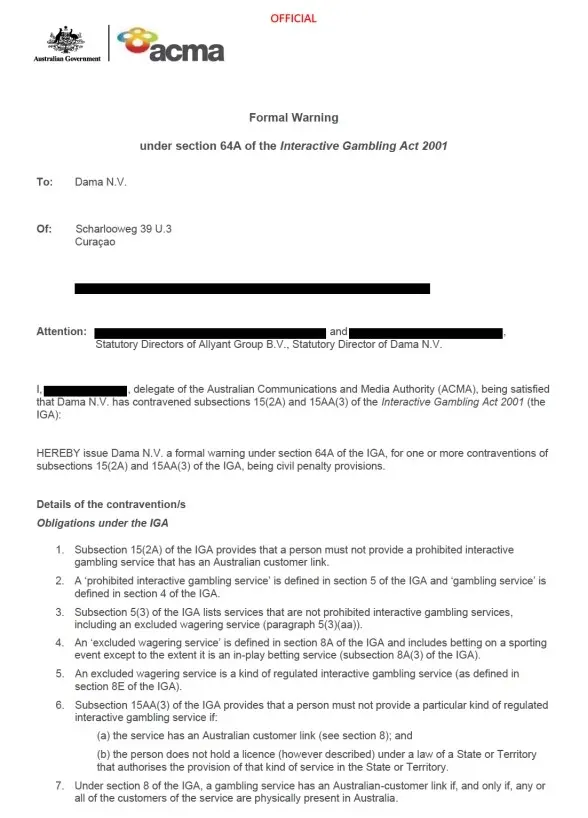
Australian online casino law is mainly a provider-side framework. Under the Interactive Gambling Act 2001, gambling providers must not offer certain prohibited interactive gambling services to people in Australia, and ACMA lists online casinos among the banned services. This is different from licensed online wagering, which can operate under Australian state or territory licensing and is covered by a separate set of consumer-protection rules. Fortune Play sits on the enforcement side of that distinction: ACMA found that the service had an Australian customer-link and that its then-provider contravened the Act by providing prohibited and unlicensed regulated interactive gambling services to customers physically present in Australia. ACMA later included Fortune Play in a February 2026 ISP-blocking action.
For readers, the useful question is not a vague “are online casinos legal?” but which service is being provided, whether the provider is authorised in Australia, and which Australian protections actually apply.
The Interactive Gambling Act 2001 in plain English
The Interactive Gambling Act 2001 is the key federal law governing online gambling services offered to people in Australia. ACMA administers and enforces the interactive-gambling rules. The Act does not treat every online gambling product the same way. ACMA’s current guidance says banned services include online casinos, in-play sports betting, sports betting services without an Australian licence, and betting on the outcome of a lottery.
That structure matters because people often use “online gambling” as if it were one legal category. It is not. A licensed Australian wagering operator is different from an offshore online casino offering slots, roulette, blackjack or similar casino products. The service type, licence status and customer location all affect the regulatory analysis.
For online casino services, ACMA’s position is direct: providers must not offer prohibited interactive gambling services to people in Australia. ACMA can investigate operators, issue formal warnings, seek civil penalties, work with other agencies, and request that internet service providers block access to websites involved in serious breaches.
ACMA’s role
The Australian Communications and Media Authority is the federal regulator responsible for enforcing the Interactive Gambling Act. It publishes guidance on prohibited services, maintains information about Australian-licensed interactive wagering providers, investigates complaints and suspected breaches, and publishes enforcement outcomes.
ACMA also uses website blocking as a disruption measure. Its blocked-websites page explains that it can ask ISPs to block a site where serious criminal or civil offences are involved, including providing prohibited interactive gambling services to customers in Australia or providing unlicensed regulated interactive gambling services.
That does not mean every gambling website blocked by an ISP has the same business model. The common point is that ACMA has reached an enforcement or disruption decision under its powers. Readers should therefore use the regulator’s own record rather than assuming that a site’s continued online presence proves Australian authorisation.
Fortune Play: Australian enforcement chronology
| Date | ACMA action or evidence | Why it matters |
|---|---|---|
| 10 December 2025 | ACMA commenced an investigation into whether Fortune Play was providing prohibited and unlicensed regulated interactive gambling services. | This is the start of the published enforcement chronology. |
| 13 January 2026 | Formal warning to Dama N.V. concerning Fortune Play. | ACMA found the service had an Australian customer-link and that Dama N.V. contravened subsections 15(2A) and 15AA(3) of the Act. |
| 13 February 2026 | Fortune Play named in an ACMA website-blocking announcement. | ACMA asked Australian ISPs to block Fortune Play after investigations found listed services operating in breach of the Act. |
| 2026 enforcement reporting | ACMA’s quarterly action reporting records Dama N.V. formal warnings including Fortune Play. | The warning forms part of ACMA’s wider published enforcement program. |
The formal warning contains the most specific findings. It says Fortune Play offered casino-style games and betting services, had an Australian customer-link, and was provided to customers using an internet carriage service. ACMA found that Dama N.V. provided a prohibited and unlicensed regulated interactive gambling service to customers physically present in Australia.
It also stated that Dama N.V. was not licensed by an Australian State or Territory to provide regulated interactive gambling services to Australians. That is why an offshore licence should not be treated as Australian local authorisation. Our separate Fortune Play licence explains the current Tobique licence statement and the operator change reflected in Fortune Play’s current Terms.
Provider prohibition versus player questions
Australian law in this area is frequently summarised badly. The Interactive Gambling Act provisions discussed by ACMA focus on the supply and advertising of prohibited or unlicensed services. That is why ACMA enforcement notices are written around what a provider offered to customers in Australia and whether it held the relevant Australian licence.
This provider-side focus should not be converted into simplistic advice that every legal, financial or tax question for a player has the same answer. Account access, payment disputes, taxation and self-exclusion all have their own rules and institutions. A player-facing guide is more useful when it keeps those layers separate.
For Fortune Play specifically, the strongest public statements are the regulator’s findings and blocking action. There is no need to add a broader label such as “fully legal in Australia” or “illegal in Australia” when the regulator record is more precise: ACMA found specific Interactive Gambling Act contraventions and took disruption action.
Licensed wagering is a different category
Australia does permit some online and phone wagering services under Australian licensing. ACMA maintains a register of Australian-licensed interactive wagering providers, and BetStop applies to those licensed online and phone wagering services. This is a different regulatory category from prohibited online casino services.
The distinction is important when discussing payment or responsible-gambling rules. For example, ACMA states that from 11 June 2024 online and telephone wagering operators cannot accept credit cards or digital currency to place bets. That rule belongs to the regulated wagering framework. It should not be misread as a rule that somehow authorises offshore online casino payments or makes a casino compliant simply because it accepts another payment method.
Likewise, a sportsbook tab appearing on an offshore casino website does not convert the whole site into an Australian-licensed wagering service. The provider and service must actually meet the Australian licensing requirements that apply to that product.
BetStop: what it covers and what it does not
BetStop is Australia’s National Self-Exclusion Register for online and phone wagering providers licensed in Australia. A person who registers can exclude themselves from covered providers in one process, and covered providers must follow the register’s requirements.
BetStop’s own guidance is equally important about the boundary: it does not apply to online casino games or other gambling services illegally provided in Australia. That means a person should not assume that an offshore online casino is covered by BetStop simply because the website accepts Australian visitors or displays sports betting alongside casino games.
This is a concrete consumer-protection difference. Australian-licensed wagering services sit inside a framework that includes BetStop. Services outside that licensed framework may not. For anyone using gambling as a form of entertainment, that difference is more practically important than a generic “licensed offshore” badge.
Consumer protection and blocked sites
ACMA repeatedly warns that illegal gambling services are unlikely to provide the same customer protections as licensed services and that Australians using them risk losing money. That warning is central to the Australian regulatory context because it explains the purpose of enforcement beyond simply naming a technical breach.
When a site is blocked, ACMA is using a disruption measure to reduce access to services it has found operating in breach of the law. Blocking does not function as a consumer compensation scheme, and it does not create a local complaints body for the offshore operator. It is therefore better understood as an enforcement tool than as a substitute for the protections attached to an Australian-licensed service.
For Fortune Play, the February 2026 blocking action belongs alongside the January formal warning. Together they show both a formal regulatory finding and a subsequent access-disruption measure.
What about tax on gambling winnings?
Tax is a separate question from whether a gambling provider is authorised to offer a service. Australian Taxation Office material states that betting and gambling wins are generally not assessable income, and gambling losses are generally not deductible, unless the person is carrying on a business of betting or gambling.
That is why this guide does not use promotional wording such as “tax-free winnings”. The ordinary-player position is generally favourable, but the business-versus-hobby distinction is fact-specific. A person’s pattern of activity, organisation and commercial character can matter.
Tax treatment also does not legalise or authorise the underlying gambling service. A tax rule about a person’s winnings and the Interactive Gambling Act rules governing providers answer different questions.
How to check whether an online gambling service is authorised in Australia
For wagering services, ACMA directs consumers to its register of Australian-licensed interactive wagering providers. A useful checking process is:
- Identify the exact service type: casino, sports wagering, lottery betting or another product.
- Find the legal entity operating the service rather than relying only on the brand name.
- For Australian wagering, check the ACMA register for the licensed provider.
- Search ACMA’s enforcement, investigation and blocked-site material for the brand and operator.
- Keep offshore licence claims separate from Australian licensing.
This process reduces the chance of confusing an offshore licence with permission to operate in Australia. It also gives more decision value than a review page that simply labels a casino “licensed” without naming the issuing authority or explaining the local position.
What this means for Fortune Play users in Australia
The practical implication is that Australian readers should not treat Fortune Play as an Australian-licensed online casino service. ACMA has published a formal warning concerning Fortune Play, found specific Interactive Gambling Act contraventions, and later included the brand in a website-blocking action.
Fortune Play’s current Terms state an offshore Tobique Gaming Commission licence for current operator Novatrix SRL. That fact can be reported directly, but it does not reverse the Australian enforcement record or create Australian local protections. The two facts describe different jurisdictions and should remain separate.
If you are comparing the brand’s commercial offer, read the promotions on its own terms rather than treating a promotion as proof of regulatory status. If your priority is risk, KYC, payments and consumer-protection context, the broader trust and consumer protection brings those issues together.
What Australian online casino law means for Fortune Play
Australia’s federal online-gambling framework does not simply ask whether a website has some form of licence somewhere in the world. The Interactive Gambling Act focuses on the services offered to people in Australia, and ACMA distinguishes prohibited online casino services from Australian-licensed wagering.
For Fortune Play, the record is unusually concrete. ACMA found contraventions involving the service and an Australian customer-link, stated that the provider named in the investigation was not licensed by an Australian State or Territory for regulated interactive gambling services, and later included Fortune Play in an ISP-blocking action. Those are the relevant Australian facts.
Return to the Fortune Play Australia review for the complete site overview, or read the licence analysis for the current offshore operator and licence details.