An operator may set no deposit floor, while payment routes, bonus turnover and withdrawal rules still determine whether a small balance is usable.

What “No Minimum Deposit” Means in Practice
“No minimum deposit” describes a setting in an operator’s account terms: the operator has not specified a floor for deposits. It does not mean that every payment route can transfer any amount, or that a deposit with no stated floor will be useful once it reaches the account. The distinction is between the operator’s rule and the limits imposed by the method used to send funds.
That difference matters when assessing claims about a no-minimum-deposit online casino. A payment provider can set a minimum transaction amount, and the operator may accept only particular methods for deposits. The amount needed to fund an account is therefore determined by the full payment chain, not by one phrase on a casino page. A displayed zero at the operator level does not cancel a payment method’s own threshold.
For Australian readers, these claims concern offshore gambling services. Real-money online casino games are prohibited from being provided to people in Australia under the Interactive Gambling Act 2001. A low deposit claim is not evidence that the service is lawful to provide in Australia, nor does it establish that a payment route will work. The deposit wording should be read as a description of terms, not as an invitation or endorsement.
A no-minimum-deposit label does not tell the whole story: check each casino’s stated deposit conditions before choosing where to play. These verdicts highlight the verified details available for this Australia-focused guide.
-
JeetCity Casino
- License
- Curacao eGaming (Dama N.V.)
JeetCity Casino is listed with a Curaçao eGaming licence held by Dama N.V.
-
House of Pokies
- License
- international iGaming licence – jurisdiction not named in the source
- Payout speed
- PayID 1-24 hours
- Min. deposit
- A$30 (PayID from A$10)
House of Pokies lists a minimum deposit of A$30, with PayID deposits from A$10, and PayID payouts in 1–24 hours. Its source describes an international iGaming licence but does not name the jurisdiction.
-
LuckyVibe
- License
- Curacao Gaming Control Board OGL/2023/176/0095 (Hollycorn N.V.)
LuckyVibe is listed under Curaçao Gaming Control Board licence OGL/2023/176/0095, held by Hollycorn N.V.
-
Rollero Casino
- License
- Curacao Gaming Control Board OGL/2023/176/0095 (Hollycorn N.V.)
Rollero Casino is listed under Curaçao Gaming Control Board licence OGL/2023/176/0095, held by Hollycorn N.V.
-
Bizzo Casino
- License
- Curacao Gaming Control Board (TechSolutions Group N.V.)
Bizzo Casino is listed with a Curaçao Gaming Control Board licence held by TechSolutions Group N.V.
-
Kingmaker
- Payout speed
- crypto ~90 minutes, fiat 1-5 days
- Min. deposit
- A$30
Kingmaker lists a minimum deposit of A$30. Its stated payout times are around 90 minutes for crypto and 1–5 days for fiat.
-
Lucky Dreams
- License
- Curacao
- Min. deposit
- A$20 (POLi)
Lucky Dreams lists a Curaçao licence and a minimum deposit of A$20 via POLi.
-
SkyCrown
- License
- Tobique Gaming Commission
- Payout speed
- crypto ~10-15 minutes, fiat 1-5 days
- Min. deposit
- A$30
SkyCrown lists a Tobique Gaming Commission licence and a minimum deposit of A$30. Its stated payout times are around 10–15 minutes for crypto and 1–5 days for fiat.
-
DragonSlots Casino
- License
- Curacao Gaming Authority (Jumpman Gaming Ltd)
DragonSlots Casino is listed with a Curaçao Gaming Authority licence held by Jumpman Gaming Ltd.
-
MrPacho
- Payout speed
- crypto 30-120 minutes, fiat 24-72 hours
- Min. deposit
- A$30
MrPacho lists payout times of 30–120 minutes for crypto and 24–72 hours for fiat, alongside a minimum deposit of A$30.
The operator’s floor and the usable floor
An operator may set no minimum while a payment method sets one. In that case, the actual minimum is the payment method’s threshold. Other practical restrictions can also matter: a payment may be rejected if it falls below the processor’s limit, or if the operator does not accept that method for the account. The operative figure is the lowest amount that can pass through the selected route under its terms.
A specialist review of Australian casino payment terms places the commonly encountered effective minimum for a usable deposit in the A$10–A$20 range. That is a reported snapshot, not a fixed rule for every operator or payment service. Terms can differ, and they can change. It should not be read as proof that any particular casino accepts a deposit at either end of that range.
This is why “no minimum deposit” and “low minimum deposit” are not interchangeable claims. The first may refer only to the operator’s own policy. The second implies that a payment route has an attainable lower amount. Even then, the amount must be checked against the route’s terms before it can be treated as an available deposit level.
A casino with no minimum deposit, as described in its own terms, may still require a higher amount through the payment option selected. Conversely, a low threshold shown for one method says nothing about the limits for another. The label alone does not establish the amount that can actually be transferred.
A very small figure is not automatically practical
Some specialist coverage of offshore operators reports cryptocurrency deposits as low as A$5. That is a specific reported example, not a market-wide minimum. It does not establish that every operator accepts that amount, or that the same threshold applies across coins and payment networks. The method and the operator’s current terms determine whether the figure is available.

A nominal amount can also be different from a usable amount. A successful transfer may place funds in an account, but the balance still has to be large enough to serve its intended purpose. That is a separate question from whether the deposit itself was accepted. A low advertised threshold therefore answers only one narrow point: the minimum stated for a particular route, under particular terms.
The distinction applies whether a page describes an online casino with no minimum deposit, an online casino with a low deposit threshold, or no minimum deposit online pokies. Different labels can refer to the same underlying arrangement: no floor set by the operator, but a floor set elsewhere in the payment process. The wording does not guarantee a zero-cost or unrestricted transaction.
Before treating a stated minimum as meaningful, the terms need to identify which payment route it applies to and whether that amount is accepted by the route itself. If the operator’s page gives no clear method-specific figure, the phrase “no minimum” does not fill in the missing detail. It describes the operator’s policy only to the extent that the terms actually support that reading.
The arithmetic is simple: the usable deposit floor is the higher applicable limit in the payment chain. If the operator sets no floor but the selected method does, the method’s minimum governs. If the method allows a smaller transfer but the operator has a higher threshold for that route, the operator’s threshold governs. “No minimum” is therefore a narrow statement about one set of terms—not a promise that any amount can be deposited or that a tiny balance will be useful.
The Australian Rules Behind Offshore Casino Access
The Interactive Gambling Act 2001 (IGA) is the main federal law governing online gambling in Australia. It makes it unlawful for operators to provide specified interactive gambling services to people in Australia. Online casino-style games—including poker, blackjack, roulette and pokies—fall within the prohibited category when offered to customers here. The rule concerns the service supplied, not whether a website describes itself as Australian, accepts Australian dollars or displays an Australian-facing brand.
That distinction matters when assessing offshore sites. Most online casinos marketed as Australian operate under licences issued elsewhere, with Curaçao, Malta and the Isle of Man among the jurisdictions commonly named. An offshore licence is not an Australian authorisation and does not displace the IGA. The operator’s location or licence may describe its position in another jurisdiction; it does not make the provision of prohibited casino services to people in Australia lawful.
The legal treatment of the operator and the individual player is not the same. The IGA prohibits operators from supplying the covered services to Australian residents, but it does not make an individual’s act of placing a bet with an offshore operator a criminal offence. That distinction should not be mistaken for approval of the service or evidence that it is protected from enforcement. The central prohibition is directed at the provision of the service.

ACMA’s role and website blocking
The Australian Communications and Media Authority (ACMA) is the federal agency responsible for enforcing the IGA and monitoring compliance with federal interactive-gambling rules. Its enforcement tools include asking Australian internet service providers to block websites that provide prohibited services or advertise them in Australia. A block can make a site inaccessible through an Australian connection, although website blocking is an enforcement measure rather than a change to the underlying law.
ACMA’s published enforcement record shows the scale of that activity. Following enforcement actions, it has blocked more than 1,455 illegal gambling and affiliate websites since November 2019. The total includes affiliate websites as well as gambling sites, so it should not be read as a count of casino operators alone.
There is also a reported difference in the number of illegal services said to have left the Australian market since enforcement began in 2017. One figure is more than 210; another is more than 190. Both describe withdrawals from the market over the same period, but the counts do not match. They are best treated as differing reported totals, not combined into a single precise number.
Blocking and market withdrawals have practical consequences for access. A site that was reachable previously may later be blocked, and the presence of a foreign licence or Australian-themed branding does not prevent that outcome. Nor does a website’s continued availability establish that its services comply with Australian law. Access can change as enforcement actions occur.
What this means for an Australian-facing casino
The phrase “no minimum deposit” concerns a payment condition, not the legal status of the service. A low entry threshold cannot alter the IGA’s restrictions on operators providing real-money casino games to people in Australia. Deposit terms and regulatory status are separate questions; one does not answer the other.
The same applies to state references in a site’s branding or marketing. A casino described as operating in New South Wales or elsewhere in Australia is not thereby authorised under Australian federal law. The relevant federal framework applies across the country, while ACMA’s enforcement role includes monitoring compliance and seeking website blocks where prohibited services or their advertising are involved.
Accordingly, offshore availability should not be confused with lawful provision. A foreign licence may exist, and a website may remain reachable for a time, but neither fact changes the federal prohibition on supplying covered online casino services to people in Australia. The legal distinction is straightforward: the operator’s provision of the prohibited service is the issue addressed by the IGA; an individual player’s act of betting with an offshore operator is not itself criminalised by that law.
Real-Money Play: The Deposit Is Only the First Threshold
A small deposit and a small cash out are separate questions. The amount accepted into an account does not, by itself, establish how much can be sent back out. A balance may be visible and available for play while still falling below the operator’s stated minimum cash-out amount. The difference matters most when the starting balance is small: a successful deposit does not guarantee that the remaining balance can be paid out immediately.

One specialist review places the minimum cash-out amount commonly encountered at A$20 to A$50. That is a reported range, not a fixed rule for every operator or payment route. The applicable terms can vary, and the amount shown in an account is not enough to determine whether a cash-out request will be accepted. The relevant figure is the minimum in the operator’s payment terms, applied to the specific account and method.
This creates a threshold beyond the initial deposit. If the balance is below the stated minimum, it may not qualify for a cash-out request. If it reaches that threshold, the amount may still be subject to other conditions in the terms. The deposit figure answers what can enter the account; the cash-out figure answers whether funds can leave it. Treating them as one limit can make a low starting balance look more flexible than it is.
The useful comparison is therefore not only “How little can be deposited?” It is also “What balance must exist before a cash-out request can be made?” A low entry amount has limited practical value if the account’s exit threshold is materially higher. The two amounts should be checked independently, and the cash-out terms should be read before any real-money activity. A headline about a small deposit says nothing about the minimum amount payable out.
The distinction also affects how a remaining balance should be interpreted. A figure in the account is not automatically equivalent to cash in hand. It may be too small to meet the stated cash-out minimum, or it may be governed by conditions that have not yet been met. Until the operator’s terms permit payment, the balance is an account figure rather than a completed transfer.
A careful assessment separates three stages: the amount accepted into an account, the balance available under the account terms, and the amount eligible for cash out. These stages can produce different results from the same initial deposit. The first threshold is the deposit; the later one is the minimum required to request payment. Where the starting balance is close to that second threshold, the gap between the two can determine whether the funds are practically accessible.
The payment terms should specify the minimum cash-out amount and any conditions attached to it. If that information is unclear, a low deposit alone cannot establish that the balance will be payable. The number that matters is not just the smallest amount that can be put in, but the amount and conditions that govern getting money back out.
Crypto Deposits: Nominal Minimums, Real Costs
A cryptocurrency payment can have a very low stated deposit floor, but that figure describes only what the casino is prepared to credit. It does not establish how much value will remain available for play after the payment is made. A specialist review reports that some casinos set a crypto deposit minimum as low as the equivalent of A$1. That is a reported example, not a dependable threshold across operators or over time.

The economics depend on more than the casino’s entry condition. A crypto transaction can carry a network cost, and the amount that reaches the account may therefore be smaller than the amount sent. Where a fee is fixed or changes little with the payment size, it takes a larger share of a small transfer. The same fee can be immaterial on a larger payment and decisive on a very small one. A low nominal minimum does not remove that arithmetic.
The practical test is the balance after costs, not the advertised minimum. If the transfer cost consumes a material part of the amount, the remaining funds may be insufficient for meaningful use. Even when the full balance is credited, game minimum bets can make a small deposit hard to use: a balance that cannot support the required stake does not become workable merely because the payment cleared.
This is why “no minimum deposit” and “deposit any amount and use it effectively” are different claims. The first may mean that the casino itself sets no meaningful floor, or sets a very low one. The second depends on the payment route and the rules that apply after crediting. With crypto, transaction costs sit between those two points.
Bitcoin is often part of searches for a casino with no deposit floor, but the label alone settles none of the relevant calculations. The minimum shown for a Bitcoin payment may be a casino setting; the amount delivered can also reflect transaction costs. Then the game’s minimum stake determines whether the resulting balance can be put to use. Each condition applies in sequence, and the smallest figure in the sequence is not necessarily the amount that matters most.
Crypto Deposit Value
-
1
Check Minimum
Verify the casino's stated minimum deposit (e.g., equivalent of A$1).
-
2
Subtract Costs
Deduct the network transaction fee from the amount sent to determine the credited balance.
-
3
Compare Stake
Check if the remaining balance meets the minimum bet required for the chosen game.
A useful comparison therefore records three separate amounts: the casino’s stated minimum, the value expected to reach the account after payment costs, and the amount needed to place a playable stake. If the last figure is greater than the available balance, the deposit is technically possible but practically stranded. If fees take a substantial share before play begins, adding a small amount may not solve the problem; it may simply repeat the same poor ratio.
The relevant question is not whether a crypto casino accepts a tiny transfer. It is whether the credited balance survives the cost of moving it and can meet the applicable bet minimum. A low threshold can be accurate and still tell very little about the usable value of the deposit.
PayID, PayPal and Other Payment Routes
A payment route can have its own floor even when an operator advertises no minimum deposit. PayID and instant bank transfers illustrate the difference between a headline and a usable transaction: a specialist payment review reports minimums of AU$10–AU$20 for these methods. That range is a report about the payment terms it examined, not a fixed rule for every operator. The amount shown at the payment screen is the one that determines whether a smaller transfer can be submitted.
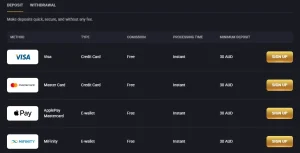
PayID may feel like a direct account payment, but it does not make a deposit floor disappear. Instant bank transfer is also subject to the terms attached to the particular route. For a small balance, a minimum above the intended deposit changes the calculation before any casino games are played: the amount available to deposit is set by the payment method, not by the wording of the promotion.
PayPal should be assessed separately. Its minimum cannot be inferred from a PayID figure or from the terms attached to another wallet. Payment providers and processors may impose transaction minimums of their own, and an operator may apply separate conditions. A PayPal option, where offered, therefore needs to be checked on its own payment screen and in its stated terms; a figure for a different route is not a substitute.
Vouchers set a clearer boundary. A Neosurf voucher purchase is typically A$10, making that purchase amount the effective floor for a deposit funded with the voucher. The voucher’s value is fixed at purchase, so a lower deposit intention cannot reduce the amount already loaded. Nor should a voucher be treated as a cash-out route: any payout must use an alternative method available under the account’s terms.
Skrill and Neteller can also bring a transaction floor and a fee into the arithmetic. A specialist payment review reports that deposits through these wallets may carry fees and often have a A$10 minimum transaction amount. Because the wording is “may” and “often,” those terms should not be treated as universal. The wallet’s own charge and the operator’s accepted minimum can both affect the amount that reaches the account.
POLi is not a current option in Australia. The service shut down on 30 September 2023, so references to it as an available deposit route are out of date. Its former presence does not establish the terms of PayID or any other bank-payment method.
The practical comparison is therefore between the amount required to fund each route, any fee deducted along the way, and the balance that actually reaches the account. “No minimum deposit” does not make those separate conditions identical. For small deposits, the payment method can set the real entry point before the advertised casino balance has any value.
PayID & Bank Transfers
Commonly reported minimums range from AU$10 to AU$20.
Neosurf Vouchers
Effective floor is typically A$10 due to the voucher purchase price.
Skrill & Neteller
Often have a A$10 minimum transaction amount and may carry additional fees.
Low-Deposit Pokies and Crypto: Where the Amount Stops Helping
A small crypto deposit can satisfy an account’s stated threshold without creating a balance that is useful for play. Those are separate tests: the first concerns whether a payment is accepted; the second concerns how much remains available after the payment arrives and how long that balance can support wagers.
A specialist review has reported offshore operators accepting crypto deposits from A$5. It has also described a nominal casino-set minimum as low as the equivalent of A$1. These are examples from a changing market, not dependable terms for every site or payment. A displayed minimum is therefore a starting condition, not a measure of practical access.
The balance has to be considered against the minimum stake for each game. If the available amount permits only a small number of bets at the permitted stake, the low entry threshold offers little room for ordinary variation in results. A balance that can technically be wagered may still be too small to make repeated play feasible. The point at which the amount stops helping depends on the game’s stake floor and the funds left after any payment costs.
Crypto can make the deposit figure look especially small because the casino’s stated minimum may be lower than the amount required for a useful session. The gap is not a contradiction: one figure is the operator’s acceptance threshold, while the other depends on the transaction and the game. A nominal deposit does not guarantee that the same amount reaches the account intact, nor that it can be used across more than a few wagers.

A practical calculation starts with the amount credited, then subtracts any transaction cost before comparing the remainder with the game’s minimum stake. If the result leaves too little for a reasonable number of permitted wagers, the advertised low threshold is largely administrative. No particular game or operator can be assumed to have a suitable stake floor; the applicable terms need to be read together.
“ No minimum deposit pokies” can also be misleading as a description of the full arrangement. It may refer to the absence of an operator-set floor, while the payment route and the game impose their own constraints. The account can accept a deposit and still provide little usable balance. That distinction matters more than the smallest figure shown beside a deposit option.
The useful measure is therefore not the smallest amount that can be sent, but the amount left to wager after costs and the stake limits attached to the game. Crypto may lower the nominal entry point. It does not remove the arithmetic that determines whether a small balance can be used at all.
Slots and Bonus Turnover: The Weighting Matters
A wagering requirement is not advanced equally by every game. The game-weighting clause determines how much of a stake is credited toward the required turnover. In the terms described for online casino bonuses, pokies typically count at 100%, while blackjack and roulette may count at only 10% or 20%.
Typical Game Weighting
Pokies typically count at 100% toward wagering requirements, while blackjack and roulette may only count at 10% or 20%.
That difference changes how quickly eligible turnover accumulates, even when the amount staked is the same. A stake on pokies credited at 100% counts in full. A stake on blackjack or roulette credited at 10% contributes only a fraction of its value; at 20%, it contributes a larger fraction, but still less than a fully weighted stake. The displayed stake and the amount credited to wagering are therefore not always the same figure.
The distinction matters when bonus terms describe a turnover target without making the game weighting equally prominent. A target can look unchanged across game types, yet the amount of play that counts toward it varies. The relevant calculation is not simply how much has been staked, but how much eligible turnover the operator records after applying the weighting.
“Pokies count at 100%” should not be read as a promise that every game in that category qualifies, or that every bonus uses identical terms. The specific promotion’s rules control which games are included and what contribution each receives. A game may be excluded, or its contribution may differ from the common weighting described above. The terms attached to the offer, rather than the game’s label alone, determine the credited amount.
This also separates game contribution from the size of the wagering obligation. A high contribution rate does not reduce the stated target; it means stakes are credited more fully toward that target. A low contribution rate does not change the stake placed, but less of it advances the requirement. Comparing games without checking that clause can therefore produce a misleading picture of progress.
For any bonus calculation, the useful line is the game-weighting table. It identifies whether pokies, blackjack and roulette count at full or partial value and whether exclusions apply. Without that detail, a turnover figure cannot be translated reliably into the amount of eligible play required.

A Bonus Can Cost More Than the Deposit
A bonus balance is not the same as cash available to take out. The wagering requirement sets a turnover target, and the promotion’s terms determine what counts towards it and when any resulting winnings can be cashed out.
A specialist review reports low-deposit bonus requirements ranging from 35× to 50× the bonus amount. At the lower end, a $1,000 bonus subject to 35× wagering requires $35,000 in qualifying bets before bonus winnings become eligible for withdrawal. The calculation uses the bonus amount, not the deposit. A small qualifying deposit therefore does not make the turnover obligation small.
The multiplier is only one part of the calculation. Before accepting a promotion, the relevant terms include the minimum deposit needed to activate it, which games contribute and at what rate, any maximum stake while wagering, and any cap on cashable winnings. A promotion may also set an expiry period. These conditions change the amount of eligible play required in practice; the headline bonus figure does not show the full cost.
A maximum-stake breach can void winnings, while a cashout cap can limit the amount payable even after the wagering target is met. Bonus funds are not ready for withdrawal simply because they appear in the account balance. The applicable wagering requirement must first be cleared, and the promotion’s other conditions must be satisfied.
The phrase “no minimum deposit” also does not establish that a bonus can be claimed without a qualifying deposit, or that winnings have no cashout threshold. Those are separate terms. The activation minimum and the rules for converting bonus-related winnings into withdrawable funds need to be read independently.
Do
- Check the wagering multiplier (e.g., 35x to 50x).
- Review game weighting tables for contributions.
Don't
- Assume a small deposit makes the turnover obligation small.
- Confuse a bonus balance with immediately withdrawable cash.
The useful comparison is therefore not bonus size against deposit size. It is the required turnover, eligible contribution, stake restrictions and cashout cap against the amount that can ultimately be withdrawn. A large bonus can carry a larger bill than the deposit that triggered it.
Bitcoin Deposits and Withdrawal Conditions
A “no minimum deposit” claim describes the amount accepted at the funding stage. It does not establish what can be paid out, which currency a cash out will use, or whether the account has met the operator’s conditions. For Bitcoin, those are separate terms and need to be read separately.
The key condition for a crypto payout is that it returns in the same coin used for the deposit. A Bitcoin deposit therefore does not create a general entitlement to receive an equivalent amount through a different cryptocurrency or payment route. The payout currency matters to the final amount received: a displayed account balance and a Bitcoin cash out are not interchangeable descriptions of value.
Speed is another distinct term. A specialist review reports that PayID and cryptocurrency are among the faster withdrawal routes in this market; it describes USDT on TRC-20 as clearing in minutes after account verification. That statement concerns USDT, not Bitcoin, and does not establish a Bitcoin payout time. Verification is also a condition in that reported timing, not a decorative step.
The useful comparison is therefore not simply “small deposit versus large deposit.” It is the amount accepted in Bitcoin, the coin required for payout, and the conditions that must be satisfied before funds can leave the account. A low entry threshold answers only the first point. It cannot, by itself, establish that a balance is ready for cash out or how quickly a Bitcoin transfer will be processed.
Before treating a Bitcoin balance as available funds, the deposit and payout terms need to be assessed together. If the withdrawal clause requires the original coin, that requirement governs the route out as well as the route in. A small stated minimum may make the initial transfer possible; it does not settle the final payment conditions.

PayPal Minimums: What Can and Cannot Be Confirmed
A casino may describe its deposit policy as having no minimum because the operator itself sets no floor. That does not establish that every payment route will accept any amount. A processor or payment method can apply its own minimum transaction value, so the amount that can actually be deposited depends on the route selected.
For PayPal, the practical distinction is between the casino’s policy and the payment service’s conditions. A stated absence of an operator-set minimum does not, on its own, establish a PayPal deposit threshold. The applicable amount should therefore be checked in the payment details shown for the specific account and transaction, rather than inferred from the phrase “no minimum deposit”.
That distinction matters when a balance is intended to remain small. If a payment route sets a minimum above the amount entered, the transfer may not proceed even though the casino has no deposit floor of its own. A displayed minimum is a condition of that route, not evidence that the casino applies the same limit to every method.
Other payment routes illustrate why figures cannot be transferred between methods. PayID and instant bank transfers have been reported with minimums in the AU$10–AU$20 range by a specialist gambling-payment review; a Neosurf voucher purchase is typically at least AU$10, which sets the practical deposit floor when that voucher is used. Those figures describe those routes, not PayPal.
The calculation is straightforward: the usable minimum is the higher of any operator-set floor and any minimum imposed by the chosen payment method or processor. When the operator sets no floor, a method-level condition can still determine the smallest accepted deposit. PayPal should be assessed on its own displayed terms; a threshold attached to another payment route is not a reliable substitute.
What is the actual minimum deposit at a no minimum deposit casino in Australia?
A usable deposit commonly has an effective minimum of A$10–A$20, because the payment method may set a floor even when the operator does not. Some offshore operators reportedly accept cryptocurrency deposits as low as A$5, but that is not a market-wide minimum.
Are no minimum deposit casinos legal in Australia?
No, offering online casino games to people in Australia is prohibited under the Interactive Gambling Act 2001, regardless of an offshore licence or a “no minimum” claim. The IGA does not criminalize an individual for placing a bet with an offshore operator.
What payment method is best for small deposits in Australia?
Cryptocurrency has the lowest reported examples, with some offshore operators accepting deposits as low as A$5, though transaction costs can make very small amounts impractical. Neosurf vouchers typically have a A$10 minimum.
What is the minimum deposit and wagering requirements?
The effective minimum for a usable deposit is commonly A$10–A$20, though some cryptocurrency deposits are reported as low as A$5. Low-deposit bonuses may require wagering of 35x–50x the bonus amount; slots typically count fully, while blackjack and roulette may count only 10% or 20%.
Can I withdraw winnings from a low deposit?
Yes, but a minimum withdrawal commonly applies, typically A$20–A$50. Bonus wagering requirements may also need to be met before bonus winnings can be withdrawn.
Do low deposit bonuses have wagering requirements?
Yes. Low-deposit bonuses may have wagering requirements of 35x–50x the bonus amount, and slots typically contribute 100% while blackjack and roulette may contribute only 10% or 20%.
Can I legally deposit and withdraw money to online casinos?
The Interactive Gambling Act 2001 does not criminalize an individual for placing a bet with an offshore operator, but it prohibits operators from providing specified online casino services to people in Australia.